
Damage Caused by a Loose Anchor: Who Is Liable at Sea?
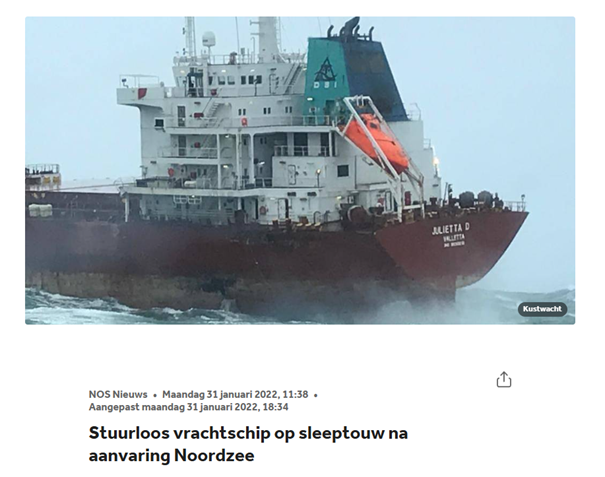
Imagine this: wind speeds of over 100 kilometers per hour, towering waves, and a massive motor vessel suddenly at the mercy of the elements. When the “Julietta D” broke loose from its anchor during Storm Corrie on January 31, 2022, and struck several objects in the North Sea, a routine stormy night turned into a maritime disaster in the North Sea. But as soon as the wind died down, a legal battle just as stormy began. After all, who pays the bill when a runaway ship leaves a trail of destruction in its wake?
Case Study: Liability for Anchor Drift and Collision
Collisions at sea are among the most complex situations in maritime law. The interplay of international treaty law, national legislation, (local) nautical rules, factual circumstances, technical aspects, and often substantial financial interests makes the resolution of such cases complex.
A high-profile case that illustrates this is that of the motor vessel “Julietta D,” which broke loose from its anchor during Storm Corrie on January 31, 2022, and struck several objects in the North Sea.
Maritime, port, and commercial lawyers Michiel van Leeuwen, Britt Simons, and Edward van Gruijthuijsen represented one of the aggrieved parties in these proceedings.
What is a collision?
The law defines a collision as “the contact between vessels” (Article 8:540 of the Dutch Civil Code). However, the legal framework for “collisions” extends beyond mere collisions between two or more seagoing vessels and also covers so-called “damage incidents” (Article 8:541 of the Dutch Civil Code).
When a collision is caused by the fault of a single vessel, the owner of that vessel is obligated to compensate for the damage. If multiple vessels are at fault, a special rule applies: the owners are then liable without joint and several liability for damage to the other vessels at fault and the cargo on board, but are jointly and severally liable for all other damage (Article 8:545 of the Dutch Civil Code).
A notable feature of collision law is the absence of statutory presumptions of fault. The burden of proof rests with the party claiming damages (Article 8:546 of the Dutch Civil Code).
The Julietta D Case: 80 million euros in damages
On January 31, 2022, Storm Corrie raged across the North Sea. In the anchorage area off the coast of IJmuiden, the motor vessel “Julietta D” broke loose from its anchor and drifted away. The drifting vessel subsequently collided with three objects: the seagoing vessel “Pechora Star,” the foundation of a Vattenfall wind turbine, and the jacket of a TenneT substation.
Damages suffered by Vattenfall, TenneT, and the owners of the “Pechora Star” were estimated at approximately €80 million. Their combined claims exceeded the limitation fund established by the vessel owner, which amounted to approximately €20 million.
The liability limit applies per incident
The concept of “the same incident” in Article 8:755 of the Dutch Civil Code (or “distinct occasion” in the LLMC) is crucial. This is because the liability limit applies per incident. If multiple damage-causing events qualify as a single incident, the joint creditors must share a single limitation fund. If the damage-causing events are to be regarded as separate incidents, multiple funds may need to be established. This may be more favorable for the injured parties.
One incident or several?
It was precisely on this point that a heated debate arose during the proceedings. Julietta D B.V. took the position that the anchor breaking loose and the three subsequent collisions together constituted a single incident. TenneT, Vattenfall, and Pechora Star argued that there were multiple independent incidents, for which multiple limitation funds should have been established.
Neither the convention nor the law specifies when an event constitutes “the same incident.” In its ruling of May 18, 2022, the Rotterdam District Court held that this was a single incident and not multiple consecutive incidents:
“The Julietta D’s collision with the Pechora Star and subsequently with the foundation of a wind turbine and the jacket of a platform was the inevitable consequence of the Julietta D breaking loose from its anchorage after the anchor chain snapped and the crew’s subsequent inability to regain control of the Julietta D. Without these latter events, the collisions between the Julietta D and the three objects would not have occurred. (…) There is thus such a causal link between the successive events that they must be regarded as a single incident.”
Conclusion: According to the court, this was a single incident and not a series of consecutive incidents.
In its ruling of May 18, 2022, the Rotterdam District Court considered
“Whether claims arise from the same event depends on whether the damages for which they seek compensation have the same legally relevant cause.”
The court of appeals ruled that even successive acts causing damage may have the same cause, but that this is not the case when the subsequent damages result from separate acts or omissions that cannot be directly attributed to the earlier cause of damage. According to the court, the mere fact that multiple contacts occurred at different times and with different objects is, in and of itself, insufficient to conclude that multiple incidents took place.
The cause: the ship breaking loose, drifting, and taking on water
With regard to the Julietta D, the court of appeals held that all three collisions stemmed from the same cause: the ship breaking loose, drifting, and taking on water. There was no evidence that the second and third collisions were due to other, independent causes of damage. The court of appeals therefore concluded that this constituted a single incident and upheld the district court’s ruling.
Consequences for the attachment
The outcome had immediate consequences for the conservatory attachments on the ship. After the establishment of the limitation fund, the court’s judge in preliminary relief proceedings lifted the attachments imposed on Julietta D, and the court of appeals upheld that judgment.
Lessons on Liability from This Collision Case
The Julietta D case offers a number of valuable insights for maritime practice. First, it underscores the importance of a careful analysis of the concept of “a single incident” in light of the limitation of liability. A thorough investigation of the facts and the collection of data and witness statements are essential.
Second, it could be inferred from these proceedings that the burden of proof regarding whether the events qualify as “a single incident” rests with the injured parties. The district court and the court of appeals appear to assume that it is up to the injured parties to demonstrate that separate incidents occurred (and that, therefore, multiple funds must be established). Whether this is correct cannot be said with certainty. It could also be argued that the party causing the damage who wishes to limit his or her liability (at the expense of the injured parties) must assert—and, if necessary, prove—that a single incident occurred.
Third, the court of appeals confirms that the LLMC aims to strike a balance between compensation for damages and the protection of shipowners against financial ruin, with the core principle being higher liability limits in exchange for an extremely limited possibility of exceeding those limits. This ensures that risks remain insurable for shipowners, a consideration that is also reflected in the Traveaux Préparatoires of the Limitation Convention.
Liability in the Event of a Collision in the North Sea? Yur Advocaten Provides Advice
The Julietta D case is a prime example of the complexity of maritime collision law. As offshore wind farms, pipeline networks, and other maritime infrastructure increasingly fill the North Sea, such incidents are expected to occur more frequently in the future. Do you have any questions or comments about this case involving liability for dropping an anchor that resulted in a collision?
Yur Advocaten advises parties involved in collisions and related limitation proceedings. In this context, Yur assists both shipowners and creditors in proceedings concerning the limitation of liability. Please contact Yur’s maritime attorneys with any further questions.

Related news:

Back to overview